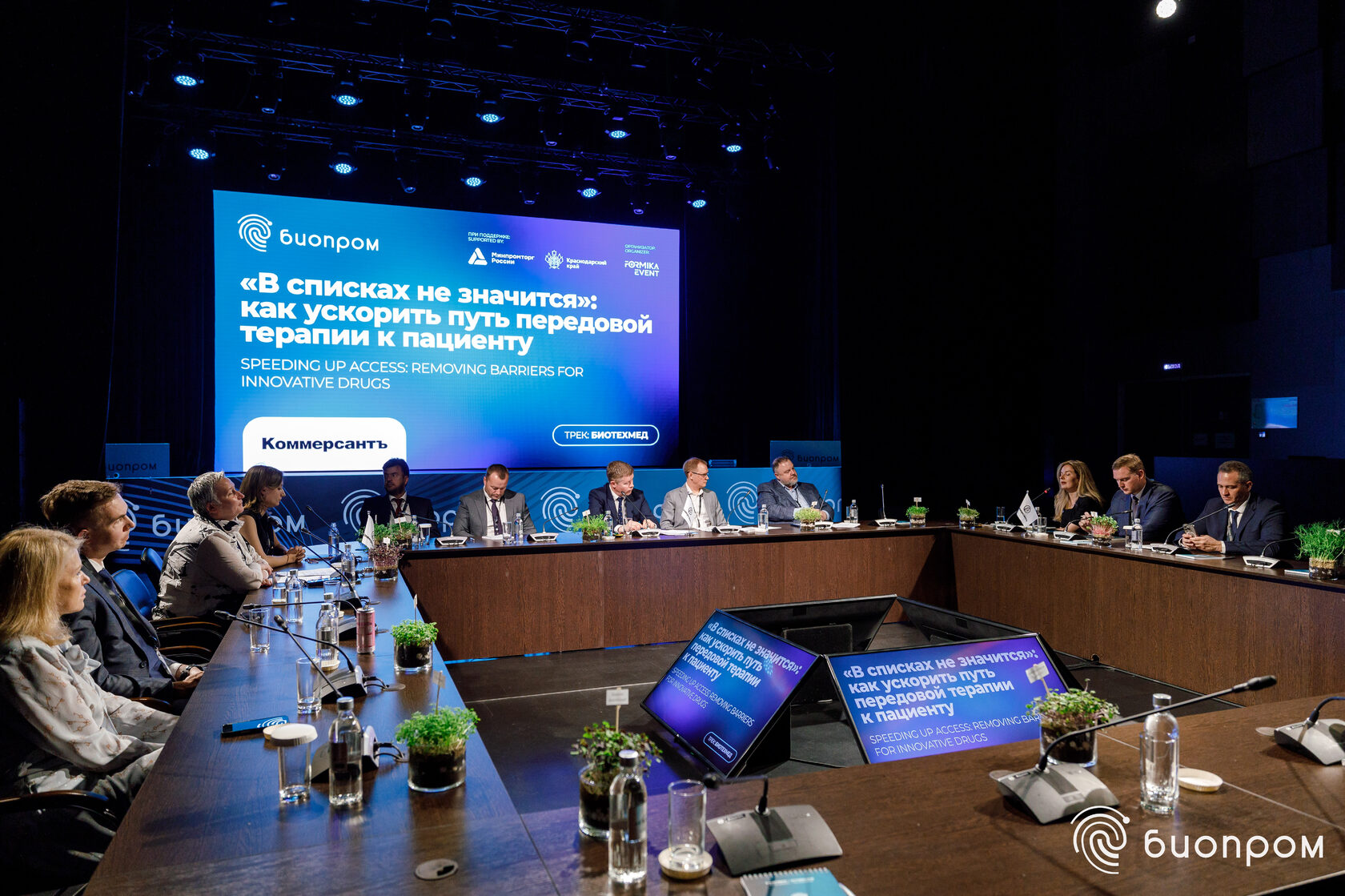
October 6 in Gelendzhik, at the “Bioprom” forum, the “Kommersant” session “Not Listed: How to Speed Up the Path of Advanced Therapy to the Patient” was held, dedicated to the launch of innovative medicines onto the market. As the discussion participants noted, a new innovative drug can enter the Russian public procurement system only two to three years after registration, and sometimes the process stretches even further. Delays are often related to the inclusion of drugs in clinical guidelines, the list of vital and essential medicines, the state guarantee program, and the compulsory medical insurance tariffs. Following the discussion, industry representatives developed specific proposals to address the problem. The session was moderated by the Kommersant producer Yuri Praslov.
Deputy Minister of Industry and Trade of the Russian Federation Ekaterina Priezzheva spoke about the main barriers and points for accelerating the launch of innovative medicines onto the Russian market. To reduce the timeframe, the Ministry of Industry and Trade sees potential in implementing artificial intelligence technologies at all stages of a drug’s life cycle — from molecular modeling and clinic search to mass production. In addition, the state is ready to expand support for pharmaceutical companies by subsidizing clinical trials not only at the production stage, but also in the first, second, and third phases. At the same time, key difficulties arise after the registration certificate is obtained, when the drug must undergo lengthy procedures to be included in restrictive lists, clinical guidelines, and state guarantee programs. Another hidden obstacle, according to Ms. Priezzheva, is the caution of the doctors themselves, who are accustomed to treatment regimens that have been tested over the years.
“There is a point we’ve talked about less — it’s a certain conservatism within the medical community, a commitment to medications that have already been tested and whose effectiveness has been confirmed by many years of practice. And trust in domestic innovative developments needs to be fostered both among the medical community and among patients.”
Co‑chairman of the All‑Russian Union of Patients Yan Vlasov called for the development of a unified, end‑to‑end state logic in the system of providing citizens with medicines. Any disruptions in the supply of life‑saving therapy or excessive bureaucracy in obtaining it pose a direct threat to patients’ lives. According to him, the isolated successes of individual research institutes, factories, or clinics will not produce a systemic effect until the entire chain is subordinated to a common goal.
<…>
The AIPM Executive Director Larisa Matveeva summarized the discussion. In her view, the availability of innovations is important for patients and the healthcare system, regardless of the country of origin of the drug. According to her assessment, the current path of an innovation from registration to the patient takes an average of four years, which, given the current pace of development (the association’s companies have more than 100 original molecules in their pipeline for the next five years), risks unacceptable delays.
“Under the current system, the medications that will be registered in the next five years will only reach the public by 2035,” said Larisa Matveeva.
To speed up access, the expert proposed reducing the timeframe for reviewing clinical guidelines for high‑priority medications from three years to six months, as well as moving the deadline for submitting the list of vital and essential medicines to the government from October to August. According to Ms. Matveeva, the latter solution is technically straightforward, but it will allow patients to gain a whole year in receiving life‑saving therapy.
For more details, check out Larisa Matveeva's interview on BIOPROM Talks:
The participants in the discussion agreed to convey the results of the discussion to the leadership of the Russian Ministry of Health.
Source: Kommersant