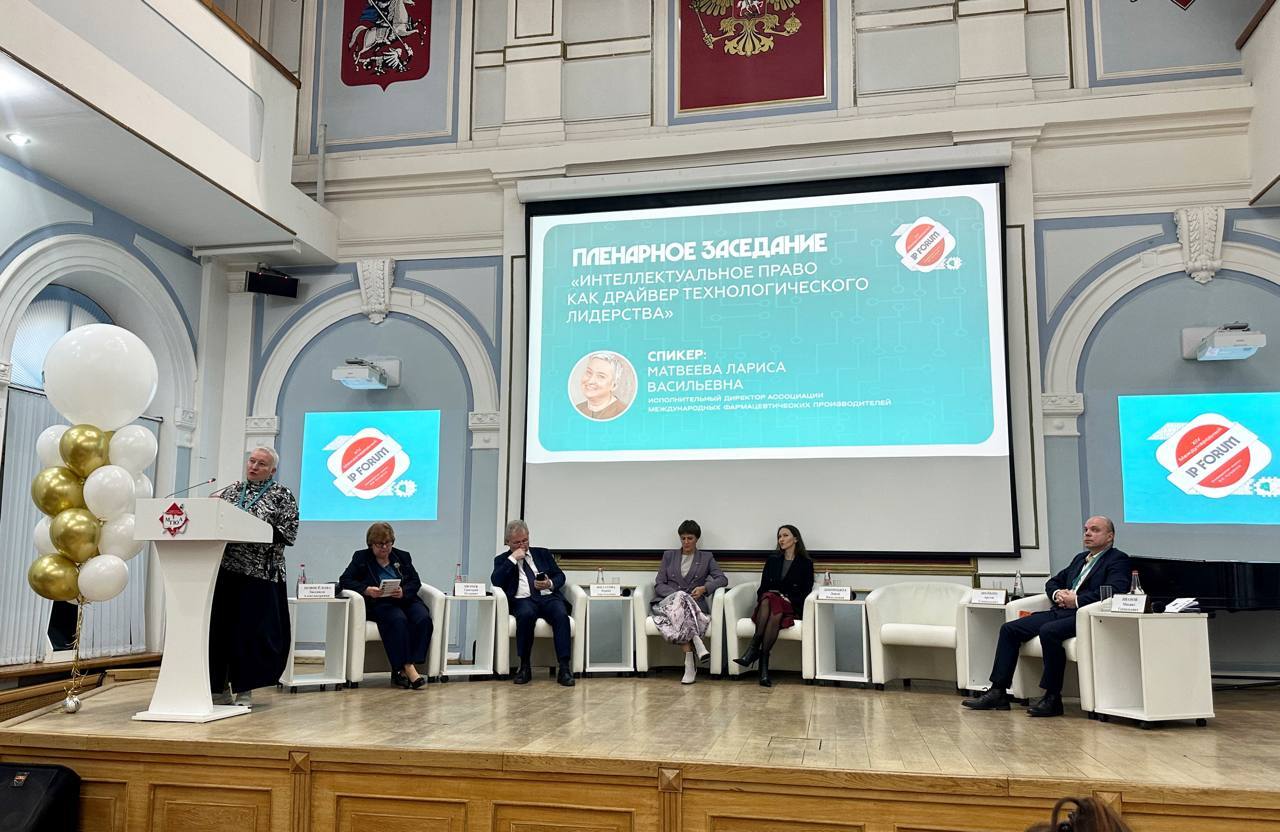
During the dialogue with representatives of legislative and executive bodies at the XIV International IP Forum, AIPM shared the pharmaceutical industry's latest perspective on crucial intellectual property protection issues. Transferring patent disputes to a specialized court, RF Intellectual Property Court, starting at first instance, will help create a uniform approaches and, as a result, minimize the use of unfair practices.
Larisa Matveeva, Executive Director of AIPM began by discussing the significance of intellectual property protection in the pharmaceutical sector. She stressed that intellectual property serves as a crucial incentive for the advancement of innovative technologies: «Without new drugs entering the market, we cannot achieve our life expectancy goals of 78 years by 2030 and 81 years by 2036,» she said. «Innovation is a priority for both foreign and Russian manufacturers, aligning with national projects.»
Grigory Ivliev, President of the Eurasian Patent Office, underscored the necessity of standardized legal measures to secure technological leadership. He emphasized that no country can achieve such leadership without fostering an environment where technological innovations receive swift, efficient, and cost-effective legal protection. This, in turn, allows them to rapidly enter both the domestic market and international markets, including those of neighboring nations.
Irina Sheikkha, Legal and IP Director at AIPM, discussed patent disputes and unfair competition in the pharmaceutical market at the round table «IP Transformation in 2026: Antimonopoly Legislation and New Challenges of Technology Transfer.» The practice has evolved to allow generic drugs to enter the market during the validity period of the original drug's patent. Without preliminary injunctions, these generics remain on the market and can participate in public procurement. A turning point came in late 2024 when the Federal Antimonopoly Service attempted to limit the introduction of such drugs before the patent expired or another legitimate reason emerged. However, these actions were challenged in court, where the outcomes remain inconsistent. «In similar disputes, courts make opposite decisions and argue their positions in various ways. But the main intrigue is yet to come: one of the cases has been accepted for consideration by the Supreme Court. Pharmaceutical market is eagerly awaiting a verdict that will definitively resolve this issue,» Irina noted, citing examples from ongoing legal cases.
At the specialized roundtable «Compulsory Licensing in Pharmaceuticals» Lyudmila Novoselova, a Doctor of Law, Professor, and Head of the Department of Intellectual Rights at the Kutafin Moscow State Law University, urged all parties to collaborate in forming unified approaches. She emphasized, «The sooner we openly discuss challenges in this field and focus on common issues, the faster we can establish consistent practices. There is nothing worse than a lack of uniformity in judicial practice, because all participants must live and “play” by fair rules.»
AIPM analyzed the state of compulsory licensing:
Among the Association's proposals for the development of the industry were the definition of an approach for analyzing the sufficiency of product supply on the market and the development of criteria for issuing licenses.
About the Forum:
The XIV International IP Forum, hosted by the Moscow State Law Institute, focused on IP leadership. The event brought together judges, policymakers, industry leaders, and academics. Key sessions included discussions on IP protection across sectors, the role of marketplaces, and the X competition «Model of the Intellectual Property Court.»
Larisa Matveeva, Executive Director of AIPM began by discussing the significance of intellectual property protection in the pharmaceutical sector. She stressed that intellectual property serves as a crucial incentive for the advancement of innovative technologies: «Without new drugs entering the market, we cannot achieve our life expectancy goals of 78 years by 2030 and 81 years by 2036,» she said. «Innovation is a priority for both foreign and Russian manufacturers, aligning with national projects.»
Grigory Ivliev, President of the Eurasian Patent Office, underscored the necessity of standardized legal measures to secure technological leadership. He emphasized that no country can achieve such leadership without fostering an environment where technological innovations receive swift, efficient, and cost-effective legal protection. This, in turn, allows them to rapidly enter both the domestic market and international markets, including those of neighboring nations.
Irina Sheikkha, Legal and IP Director at AIPM, discussed patent disputes and unfair competition in the pharmaceutical market at the round table «IP Transformation in 2026: Antimonopoly Legislation and New Challenges of Technology Transfer.» The practice has evolved to allow generic drugs to enter the market during the validity period of the original drug's patent. Without preliminary injunctions, these generics remain on the market and can participate in public procurement. A turning point came in late 2024 when the Federal Antimonopoly Service attempted to limit the introduction of such drugs before the patent expired or another legitimate reason emerged. However, these actions were challenged in court, where the outcomes remain inconsistent. «In similar disputes, courts make opposite decisions and argue their positions in various ways. But the main intrigue is yet to come: one of the cases has been accepted for consideration by the Supreme Court. Pharmaceutical market is eagerly awaiting a verdict that will definitively resolve this issue,» Irina noted, citing examples from ongoing legal cases.
At the specialized roundtable «Compulsory Licensing in Pharmaceuticals» Lyudmila Novoselova, a Doctor of Law, Professor, and Head of the Department of Intellectual Rights at the Kutafin Moscow State Law University, urged all parties to collaborate in forming unified approaches. She emphasized, «The sooner we openly discuss challenges in this field and focus on common issues, the faster we can establish consistent practices. There is nothing worse than a lack of uniformity in judicial practice, because all participants must live and “play” by fair rules.»
AIPM analyzed the state of compulsory licensing:
- 80% of all compulsory license claims since 2017 were filed in 2024-2025
- There is a trend towards holding closed court sessions under compulsory licenses
- The main subject of disputes is the insufficient supply of goods on the market
- The industry supports proposals to improve intellectual property protection by transferring all intellectual property rights cases to the IPR and supporting necessary legislative changes to implement interim measures.
Among the Association's proposals for the development of the industry were the definition of an approach for analyzing the sufficiency of product supply on the market and the development of criteria for issuing licenses.
About the Forum:
The XIV International IP Forum, hosted by the Moscow State Law Institute, focused on IP leadership. The event brought together judges, policymakers, industry leaders, and academics. Key sessions included discussions on IP protection across sectors, the role of marketplaces, and the X competition «Model of the Intellectual Property Court.»